Etsy

Friday, 8 October 2010

The most mobile nation

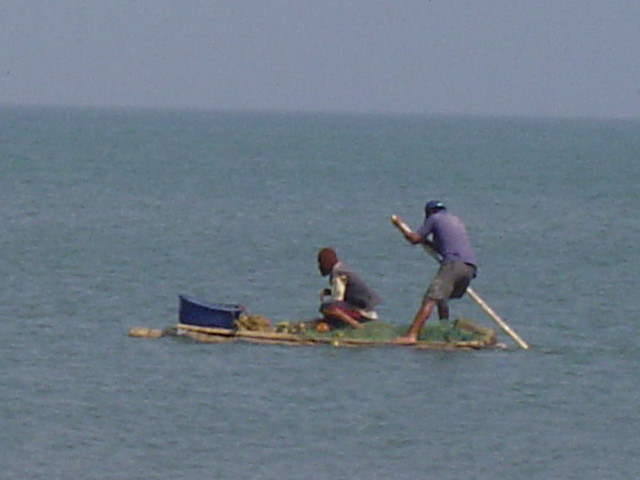
The most mobile nation in the world is the Island state of Karmisticia, which was originally found in the Indian Ocean. Uninhabited until the early Twentieth Century, due to its isolation from any populated areas, it was supported by a thin column of igneous rock reaching up from the Sea-bed. This was destroyed due to disturbances from the eruption of Krakatoa, but the island stayed afloat, due to the unique buoyancy of its natural rock. It became a nation in 1905, when a shipwrecked crew of Indian fishermen washed up on its shores, having believed themselves to be doomed, as there were no reported islands anywhere near where their ship had sunk. Although the men returned to India for supplies and their families, they were determined to make the Island their home, and named it Karmisticia. Karmisticia has continued to drift, and has most recently been sighted passing Norway.

Two citizens of Karmisticia re-enact the discovery of the island, a ritual repeated on March 14th every year. As the population of the island rarely exceeds 30, and constantly changes as the island passes by other countries or picks up international criminals looking for a place to lie low (which Karmisticia offers, due to its lack of extradition treaties with the rest of the world, itself a result of the fact that Karmisticia is rarely close enough to any country long enough to establish full diplomatic relations), anyone residing on the island for longer than 3 weeks has to agree to take part in at least one commemoration.Photographed by travel agency chifa217.
©2010 James Mathurin

Thursday, 23 September 2010

The inventions of Dimitri Dutruv Pt. 5

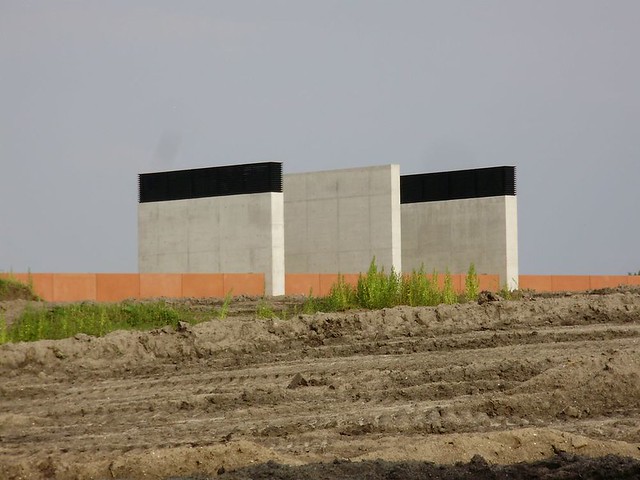
After hearing of a school that faced difficulty in its fire and bomb evacuation plans, due to severely limited space on the school grounds, Dutruv developed a system to offer protection from explosions or intense heat to crowds gathered a short distance from the source of such threats. This involved underground blast shields being situated in a protective ring around the site in question. The blast shields would be reinforced concrete, 75cm thick, 6m wide and 4m high, which could be raised to their full height within 0.45 seconds by a powerful system of hydraulics, which could be activated by a remote control when all persons were outside the protective ring. One prototype was actually installed in an Australian High School, but was removed after a trial evacuation when a Year 10 pupil was accidentally catapulted 15m into the air by a premature firing of the blast shield mechanism.
Several of the blast shield being removed after the Year 10 student, who can only be identified as "Jayden" after a court ruling which also prevents the school from being identified, recovered from his injuries. He was saved from certain death by landing in the school's outdoor swimming pool. Photograph provided by uair01.

©2010 James Mathurin

Saturday, 18 September 2010

The least-noticed middle name

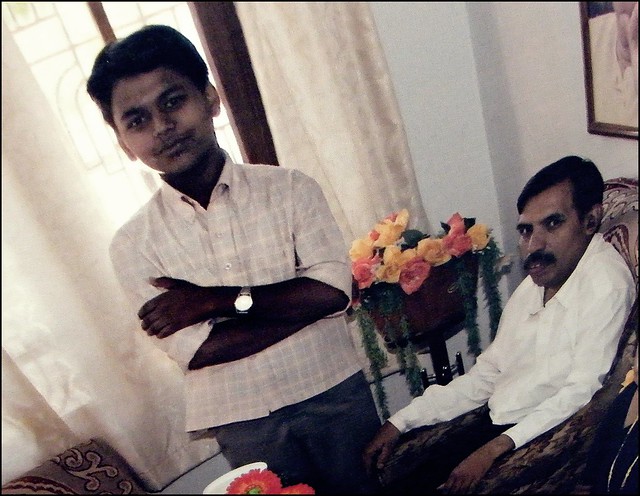
The world’s least-noticeable middle name is “ “. It is the middle name of Harold   Bashouka, born in 1967. Bashouka’s parents, Gibbe and Henkara, both of whom are judges in their native Poland, actually stipulated that on any official form, there must be an extra space between his forename and surname, or his initials can be represented as “H.   . Bashouka.” Speaking at Harold’s inauguration as President of the local Flint Collector’s club, Gibbe Bashouka explained, “We hoped that, by putting a little void into his name, we could encourage our son to stop and meditate every time he thinks about himself.”

This photograph of of Harold (l) and Gibbe (r) Bashouka is on display at the Warsaw Flint Collector's Association. The frame is inscribed "In commemoration of our third-greatest President, H. . Bashouka, and the parent whose name-based motivation pushed him to the heights which he achieved.". The photo is now property of U-g-g-B-o-y-(-Photograph-World-Sense-).

©2010 James Mathurin

Monday, 13 September 2010

The inventions of Dimitri Dutruv Pt. 4

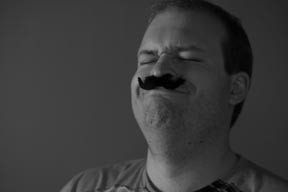
Dutruv's plans for the Mechanical moustache never got much further than a prototype which he tested on one subject. His original designs showed that he had envisioned it as "a device allowing the modern man-on-the-go to discreetly have at his disposal several useful devices, such as a toothbrush, cigarette lighter, collar-affixer and neck-massager, all operated by animatronic appendages concealed by a manly moustache, which could be groomed to a handlebar design, or any other style, as whimsical fashions will inevitably dictate."

This image of the mechanical moustache was captured in a photograph which has since been donated by the Dutruv estate to the Art Institute of Portland. The subject, Dutruv's sometime laboratory assistant Tomasz Kolvski, described the sensation of the automated features as, "Initially foreboding, but afterwards, quite comfortable." The prototype was abandoned after Kolvski was injured by the cigarette-lighter feature, although unsubstantiated rumours persisted for some time that the Dutch military had purchased the rights to develop a weaponised version of the automated moustache from Dutruv.

©2010 James Mathurin

Thursday, 9 September 2010

The shortest acceptance speech

The shortest ever acceptance speech in a mayoral election lasted 1.74 seconds, and was delivered in 1967 by Arnosue Gharfinsal, when he was elected in the town of Bandaicooler, on the island of Tasmania. Standing outside the town hall, he announced, “I’m a man of few words,” before going inside for a nap.

Arnosue Gharfinsal, pictured before making what was actually a shorter speech, at just 3.8 seconds, to the Tasmanian Chamber of Commerce in 1984. Unfortunately, there has been controversy over the length of the speech, due to the 3 minute ovation he received between the second and third words of the speech ("Salt," and "Tourism"). Photo provided by euthman.

©2010 James Mathurin

Thursday, 26 August 2010

The inventions of Dimitri Dutruv Pt. 3

Dimitri Dutruv developed the electric wig over the winter of 2003-4. In his design notes he said that the concept came to him while he was camping with his uncles in the Black Forest, 
"We found ourselves uncommonly annoyed by swarms of mites, midges and associated insects. I was reminded of the 'Insect-o-cutor' I had seen in a local butchers earlier that day. I was trying to imagine a suitable method of making such a device portable, when i could not help but to have my attention drawn to Uncle Berni's awful hairpiece. If a man was willing to wear such a thing for reasons of pure vanity, why not then one which could protect him from 6-legged annoyance?"
Dutruv developed an wig, filled with filaments of conductive wire, insulated against the scalp by a shower cap lining the interior, and a power source worn on a belt around a waist. The device could be activated by a switch on the belt buckle, which sent a charge through the wig, electrifying any insects which came into contact with it.

Dutruv's Uncle Yuri models the electric wig at his family home in 2004. There appears to have been a falling out between them after this photograph was taken, and it may have been caused by a house fire which was likely caused by the wig. Photograph provided by CarbonNYC.

©2010 James Mathurin

Thursday, 19 August 2010

Worst ever recorded orchestral recital

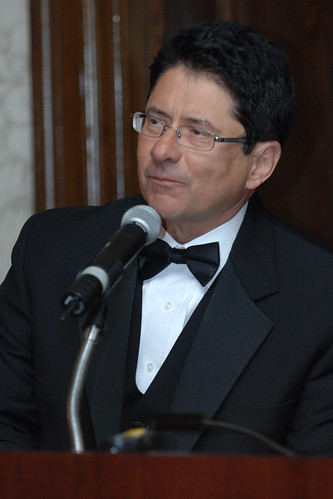
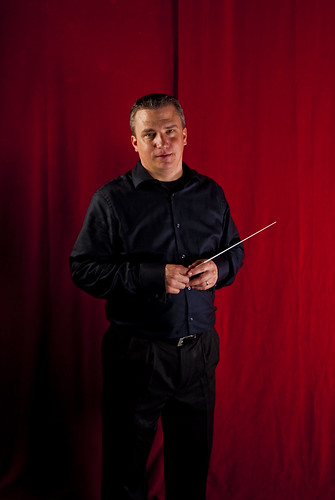
The worst ever recorded Orchestral recital was of Der Fleidermaus, and was performed by the Lisbon Philharmonic on August 19th 1967, at the Lisbon City Hall. Due to a problem with the hall’s central heating, the concert only went ahead because of the crippling financial problems faced by the orchestra’s owner, Plankton magnate Guiseppe Bounhi, who was hoping to sell the recordings through the LPO’s official newsletter. The heat caused all of the string instruments to fall out of tune, along with several of the woodwind instruments, whose lacquer softened. Also, as the concert continued, 13 members of the orchestra eventually passed out, until the concert was ended prematurely when a timpani player fainted and fell into a tuba. The conductor, Fredo Ballon, was quoted afterwards as saying, “I don’t think it could have been worse if you had asked Miles Davis to play in a sauna.”

Fredo Ballon, pictured here in 1972, when the Lisbon Philharmonic attempted to perform Der Fleidermaus again. Problems occurred again, this time because a bassoonist had accidentally allowed his pet ferret to escape during a rehearsal, and it had nested and given birth to young inside a cello. Ballon recalled in his autobiography Musings on Tempo, that, "The cacophony when the second strings came in was mind-boggling, but after the 1967 debacle, I was determined to see it through. By the time we reached the final act, the vibrations from the cello had either rendered the animals unconscious or killed the. I never checked. That is not my job." Photo provided by Crazyflyinmidget.

©2010 James Mathurin