Etsy

Showing posts with label science. Show all posts

Sunday, 21 December 2014

Sunday, 7 December 2014

Sunday, 8 June 2014

Longest Nasal Hair Infographic

The human body - capable of amazing things (and lots of other things...I mean, I'm sure you can think of at least a couple. Well, maybe not that one...).

©2014 James Mathurin

Sunday, 15 December 2013

Monday, 25 February 2013

The lightest ever bulldozer


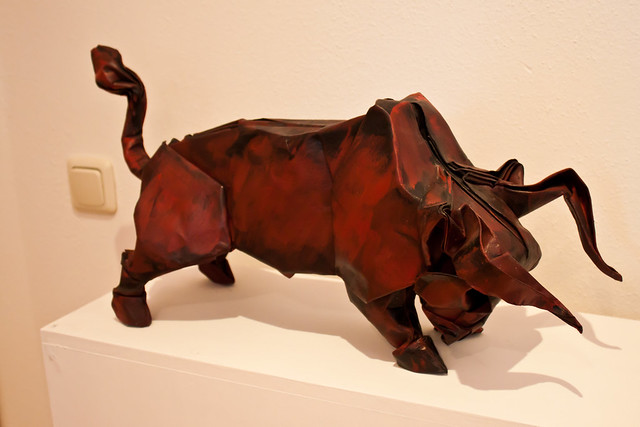
The lightest ever bulldozer was constructed by Hiromi “Shogun of Origami” Shumizuko of Tokyo, Japan. The working model, constructed almost entirely of construction paper, weighed in at 22 kilograms, and was used by Shumizuko to plough an acre of grassland in Shiretoko National Park, on the island of Hokkaido, Japan, in March 2002, until it collapsed in a light shower.


An origami bull which was also constructed by Shumizuko to accompany the origami bulldozer and a planned tractor in a field for an outdoors "Henry Moore-style" installation". When the bulldozer was ruined, Shumizuko abandoned the tractor project, and sold the bull to a private collector. Photograph by Scarygami.
 ©2013 James Mathurin 

Monday, 11 February 2013

The first football club to be managed by a computer


The first football club to be managed by a computer was Worksop Town, whose chairman, Terrence Mawinney, insisted on installing the Artificintellimac 5.1 as manager after the club fired Peter Jacksmith from the position in the 1988/89 season. The computer, built my Mawinney’s company, Winneyworks, guided Worksop to third place in the Shamois Leather East Division, their highest position for 7 years, until it was corrupted by a virus, and substituted the left-winger for a cashier from the club shop, and sold the stadium’s goal-posts to hire a new physio. The Artificintellimac was removed as manager with five games of the season left, after being given the chairman’s “complete support.”
Terrence Mawinney is pictured here conducting a tour around Winneyworks' factory for potential investors. Many fans have suggested that Mawinney only installed the Artificintellimac as manager as a publicity stunt, but Mawinney's daughter suggested, in an interview with Techslice magazine, that Mawinney had, over his lifetime, developed an obsession with Artificial Intelligence, and sought out any opportunity to place computers into traditionally human roles. She also intimated that a "restricted area of the factory was devoted to an ultimately failed attempt to construct an "artificial wife" for Mawinney, according to his stipulations, one of which was an appreciation of football. Photograph by NRCgov.
 ©2013 James Mathurin

Monday, 4 February 2013

The world’s oldest chad


The world’s oldest chad is over 7, 000 years old. It was found by archaeologist Shrivnee Bambaclart, on a dig near the site of the Sphinx in Egypt in 2001. “I can categorically state that this is a chad, and not a simple disc of paper,” said Bambaclart, announcing her discovery, “Electron Microscope analysis of its edges reveals that it was punched and not cut from a larger sheet of papyrus. What is truly fascinating, though, is that it predates the use of papyrus in Egypt, and certainly predates the use of even the most primitive of hole-punchers. I truly believe that this may represent a link to the truth behind the legend of Atlantis.”
The chad is analysed under electron microscopes at laboratories in Cyprus in 2002. Bambaclart's team, afte confirming the age of the chad, are planning to return to the dig site to confirm rumours of similarly-aged staples. Photograph by Robert Scoble.

©2013 James Mathurin

Tuesday, 28 June 2011

The inventions of Dimitri Dutruv Pt. 6

One of Dutruv's more controversial, and less well documented scientific escapades was his 'Metro Mass Driver' series of experiments. These represented the period where Dutruv developed an interest in the self-styled "Guerrilla Science" movement, which encouraged,
Systems of experimentation and technological development, freed of corporate and government sponsorship, staid academia and restrictive Health and Safety restrictions, by utilising the environment and resources we find in it.

For Dutruv, this involved utilising several miles of the Tunnelbana Metro system in Stockholm in order to attempt to turn an unmanned Maglev (Magnetic Levitation) vehicle as a 'DIY mass driver', in order to create 'miniature Black Holes'. Although Dutruv often worked alone, the scale of this project required him to ask for assistance from Guerrilla Science, specifically to help him hack into the Tunnelbana computer system to ensure that no staff were working overnight on the sections of track he was using, and to use two assistants he recruited from advertisements in magazines and tobacconists. Records of what happened are legally sealed by the Swedish government, but Dutruv was arrested and faced legal charges, and at least one of his assistants may have been removed from the spacetime continuum as a result of the experiment.

This picture was taken by 'Guerrilla Scientist' Pacopus, and is said to show Dutruv, the surviving assistant, and the unidentified 'hypothetical' assistant, who has come to be known in online discussions as 'Assistant H'.

Dutruv was released from the custody of the Swedish police without being charged. The investigating officer, Faltmo Lindegaard, explained,
While we do feel that some kind of offence took place here, our suspicion is that the victim, if indeed there ever was one, has been erased from all of time and space, and as such, the crime remains purely hypothetical, even though we believe that it did happen. This is confusing, and well beyond our jurisdiction.

Although details of this investigation were not included in the remains of Dutruv's work, after his death in 1996, several of the 'Guerrilla Scientists' who knew of it posted discussions about it on various online message boards, saying that they felt it should stand as a tribute to Dutruv's contribution to human understanding.

©2011 James Mathurin

Thursday, 23 September 2010

The inventions of Dimitri Dutruv Pt. 5

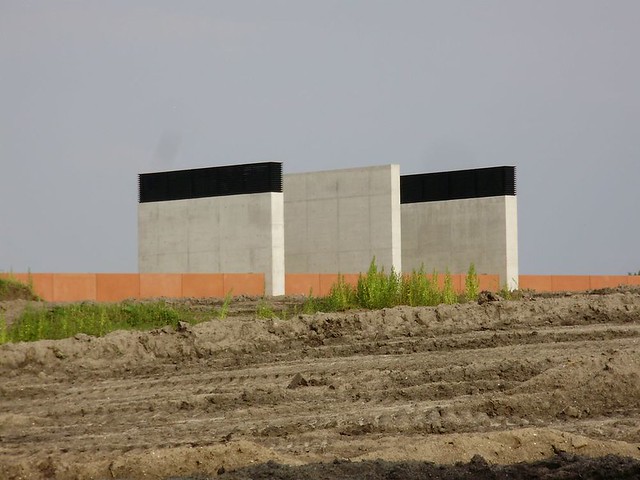
After hearing of a school that faced difficulty in its fire and bomb evacuation plans, due to severely limited space on the school grounds, Dutruv developed a system to offer protection from explosions or intense heat to crowds gathered a short distance from the source of such threats. This involved underground blast shields being situated in a protective ring around the site in question. The blast shields would be reinforced concrete, 75cm thick, 6m wide and 4m high, which could be raised to their full height within 0.45 seconds by a powerful system of hydraulics, which could be activated by a remote control when all persons were outside the protective ring. One prototype was actually installed in an Australian High School, but was removed after a trial evacuation when a Year 10 pupil was accidentally catapulted 15m into the air by a premature firing of the blast shield mechanism.
Several of the blast shield being removed after the Year 10 student, who can only be identified as "Jayden" after a court ruling which also prevents the school from being identified, recovered from his injuries. He was saved from certain death by landing in the school's outdoor swimming pool. Photograph provided by uair01.

©2010 James Mathurin

Monday, 13 September 2010

The inventions of Dimitri Dutruv Pt. 4

Dutruv's plans for the Mechanical moustache never got much further than a prototype which he tested on one subject. His original designs showed that he had envisioned it as "a device allowing the modern man-on-the-go to discreetly have at his disposal several useful devices, such as a toothbrush, cigarette lighter, collar-affixer and neck-massager, all operated by animatronic appendages concealed by a manly moustache, which could be groomed to a handlebar design, or any other style, as whimsical fashions will inevitably dictate."

This image of the mechanical moustache was captured in a photograph which has since been donated by the Dutruv estate to the Art Institute of Portland. The subject, Dutruv's sometime laboratory assistant Tomasz Kolvski, described the sensation of the automated features as, "Initially foreboding, but afterwards, quite comfortable." The prototype was abandoned after Kolvski was injured by the cigarette-lighter feature, although unsubstantiated rumours persisted for some time that the Dutch military had purchased the rights to develop a weaponised version of the automated moustache from Dutruv.

©2010 James Mathurin

Thursday, 26 August 2010

The inventions of Dimitri Dutruv Pt. 3

Dimitri Dutruv developed the electric wig over the winter of 2003-4. In his design notes he said that the concept came to him while he was camping with his uncles in the Black Forest, 
"We found ourselves uncommonly annoyed by swarms of mites, midges and associated insects. I was reminded of the 'Insect-o-cutor' I had seen in a local butchers earlier that day. I was trying to imagine a suitable method of making such a device portable, when i could not help but to have my attention drawn to Uncle Berni's awful hairpiece. If a man was willing to wear such a thing for reasons of pure vanity, why not then one which could protect him from 6-legged annoyance?"
Dutruv developed an wig, filled with filaments of conductive wire, insulated against the scalp by a shower cap lining the interior, and a power source worn on a belt around a waist. The device could be activated by a switch on the belt buckle, which sent a charge through the wig, electrifying any insects which came into contact with it.

Dutruv's Uncle Yuri models the electric wig at his family home in 2004. There appears to have been a falling out between them after this photograph was taken, and it may have been caused by a house fire which was likely caused by the wig. Photograph provided by CarbonNYC.

©2010 James Mathurin

Monday, 2 August 2010

Fastest growing nasal hair

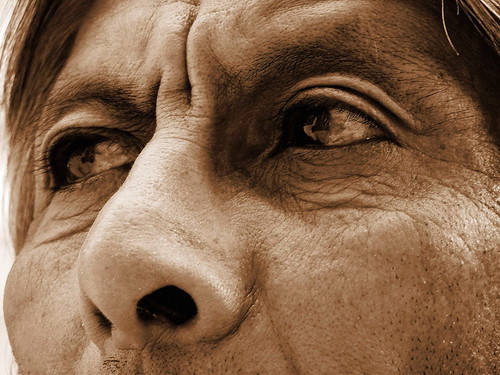
The fastest growing human nasal hair belonged to Venezuelan Paco Nibrez. His hair grew at a rate of 1cm every 17hours, for a period of 5 weeks in 1974. Nibrez could find no medical explanation for his condition, and eventually came to blame it upon a curse, which he believed had been placed on him by a witchdoctor for running over a farmer’s prize goat.

Paco Nibrez, pictured after the nose hair had been trimmed, and had returned to a normal rate of growth. Nibrez commented, "They cannot tell me why it happened, or why it has stopped. I do not need their answers. I know why it was, and if I could bring that goat back, I would. I am just grateful that my prayers have been answered, and that my nostrils are no longer home to evil." Photo provided by ruurmo.

©2010 James Mathurin

Sunday, 27 June 2010

The inventions of Dimitri Dutruv Pt. 2

Continuing the collection of inventions developed by Dimitri Dutruv, we now move onto the APG (Automatic Platitude Generator). In 2003, Dutruv was charged with developing a machine for automatically writing messages in greeting cards. Creating a series of stamps on rotating gears, with words like "best", "mum", "sweetest", "forever", "teacher", "pearly-lipped", "mechanic", "sorry", "niece", "this year", "tender", which could be printed into any card. It also featured a pulping chamber where cards, paper and leaflets could be fed in and mashed up to make new colours.

Although Dutruv believed that it could have been developed into a perfectly effective working model, his prototype cards were not to the satisfaction of the investor, due to what Dutruv described as "a currently unmanageable platitude randomisation factorisation."

One of the prototype cards produced by the APG. Unfortunately, it was supposed to be a 'commiseration card for the death of a grandparent', but appeared with this design, and the message, "Sweet tender Yom Kippurs, Auntie!" Image supplied by Boby Dimitrov.


©2010 James Mathurin