Etsy

Showing posts with label inventor. Show all posts

Sunday, 24 May 2015

Dimitri Dutruv Infographic #12: Conspiracy Theory Technology

It's a good point. Conspiracy theories just seem to create lots of unnecessary stress. Unless they're true...

But they're not.

©2015 James Mathurin

Sunday, 25 January 2015

Dimitri Dutruv Infographic #11: Musical Seaweed

It would have been interesting to see what the combined effect of musical seaweed and offshore wind farms would have been, but, alas, we can only imagine.

©2015 James Mathurin

Sunday, 23 November 2014

Tuesday, 8 July 2014

The most corrosive hamburger sauce Infographic

Being in Australia, it's Winter now, so barbecues are at a minimum, but someone somewhere is firing up the grill, and my advice to you is not to use this sauce.

©2014 James Mathurin

Sunday, 11 May 2014

The Inventions of Dimitri Dutruv, Pt.8 Infographic

It can be argued that Dutruv was thoroughly unqualified for this kind of work, and that the subjects were vulnerable people who shouldn't have been treated in this manner. I'm not sure what the counter-argument would be...

©2014 James Mathurin

Sunday, 15 December 2013

Sunday, 2 June 2013

The inventions of Dimitri Dutruv pt.10

After having developed technology for converting sound to smell, Dutruv embarked on a more ambitious offshoot of the project.

Having converted sounds to smell, Dutruv was convinced that language, meaning and, eventually, words, could be converted into specific smells. To this end, while working on several other projects over a 3 year period, he developed a "smell dictionary", a collection of 35,000 words (with 35,000 meanings), encoded as a series of scents, recorded on specially-treated pages.


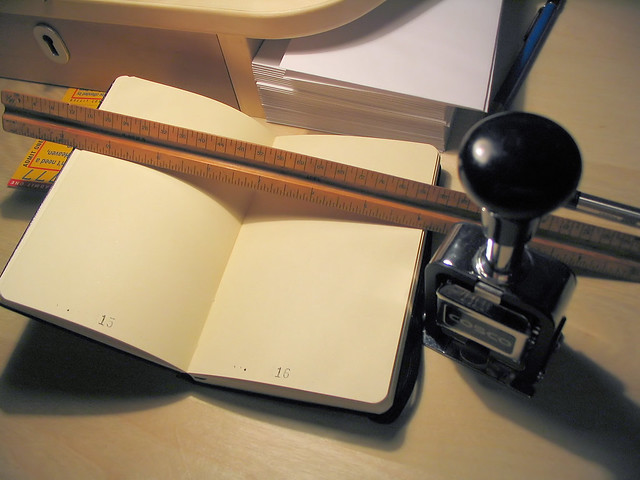
This photograph shows an early test version of the smell dictionary (with only 1,500 words), which Dutruv used to test different treatments for stopping different 'smell words' blending into each other. 
Some pages are still annotated (in conventional pen) with comments such as,
"Some spreading between 'goose' and 'gondola'. Distinct impression of a bird-shaped boat, similar to those found in some amusement parks formed. Interesting, but a failure to clearly communicate meaning."
Photograph by J Dueck.


 ©2013 James Mathurin 

Sunday, 28 April 2013

The Inventions of Dimitri Dutruv pt. 9

After becoming fascinated by the phenomenon of synaesthesia in the mid 1980s, Dutruv started research to develop technology to convert information from one sense into another. After experimenting with conversions between sound and taste, smell and sound, touch and vision and vision and taste, in 1987 Dutruv was able to establish a mechanism for converting smell to sound.

To demonstrate the technology, he converted several pieces of music into smell, using a series of chemical sprays to correspond to the different sounds. Those pieces included:

Mozart's Eine Kleine Nachtmusic;
An instrumental version of The Beatles song Penny Lane;
Several tracks from Kraftwerk's Tour De France album, and;
Jimi Hendrix's seminal performance of The Star Spanged Banner, recorded live at Woodstock.

Although the technology worked successfully, the mix of chemicals induced allergic reactions in several of the participants.
Margerie Fontaine, a french test subject who volunteered to take part in the Penny Lane section of testing in Spring of 1988. In her debriefing after completion of the tests, she said, "I'm more of a Wings fan, but the smell of the Beatles makes me appreciate their work in many different ways." Photograph by by The Consortium.

 ©2013 James Mathurin

Tuesday, 28 June 2011

The inventions of Dimitri Dutruv Pt. 6

One of Dutruv's more controversial, and less well documented scientific escapades was his 'Metro Mass Driver' series of experiments. These represented the period where Dutruv developed an interest in the self-styled "Guerrilla Science" movement, which encouraged,
Systems of experimentation and technological development, freed of corporate and government sponsorship, staid academia and restrictive Health and Safety restrictions, by utilising the environment and resources we find in it.

For Dutruv, this involved utilising several miles of the Tunnelbana Metro system in Stockholm in order to attempt to turn an unmanned Maglev (Magnetic Levitation) vehicle as a 'DIY mass driver', in order to create 'miniature Black Holes'. Although Dutruv often worked alone, the scale of this project required him to ask for assistance from Guerrilla Science, specifically to help him hack into the Tunnelbana computer system to ensure that no staff were working overnight on the sections of track he was using, and to use two assistants he recruited from advertisements in magazines and tobacconists. Records of what happened are legally sealed by the Swedish government, but Dutruv was arrested and faced legal charges, and at least one of his assistants may have been removed from the spacetime continuum as a result of the experiment.

This picture was taken by 'Guerrilla Scientist' Pacopus, and is said to show Dutruv, the surviving assistant, and the unidentified 'hypothetical' assistant, who has come to be known in online discussions as 'Assistant H'.

Dutruv was released from the custody of the Swedish police without being charged. The investigating officer, Faltmo Lindegaard, explained,
While we do feel that some kind of offence took place here, our suspicion is that the victim, if indeed there ever was one, has been erased from all of time and space, and as such, the crime remains purely hypothetical, even though we believe that it did happen. This is confusing, and well beyond our jurisdiction.
Although details of this investigation were not included in the remains of Dutruv's work, after his death in 1996, several of the 'Guerrilla Scientists' who knew of it posted discussions about it on various online message boards, saying that they felt it should stand as a tribute to Dutruv's contribution to human understanding.

©2011 James Mathurin

Sunday, 26 June 2011

The most corrosive hamburger sauce

The most corrosive Hamburger sauce ever was Kathter’s Old Number 9, a concoction created on a Texan farm in 1972 by retired Chemist Peter Chan. Although he kept the ingredients secret, he told Hamburger Review magazine, “it contains 5 different types of chillies, and gunpowder for seasoning.” Chan was later taken to court by PETA, accused of killing several sows by testing his sauce on them when it was still in its experimental stages. Kathter’s Old Number 9 was eventually taken off the shelves in 1975, when it was discovered that one of the ingredients used  by Chan had actually been extracted from the larval form of a rare parasitic wasp which was on the Endangered Species list.

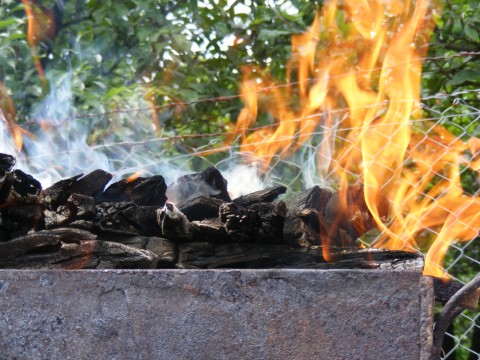
The results of the application of 75ml of Kathter’s Old Number 9 to an undercooked quarter pounder. Chan noted that the bottle did carry the disclaimer "contents may become volatile if brought into contact with raw meat products." Photo copyright of Public Domain Photos.
©2011 James Mathurin

Thursday, 23 September 2010

The inventions of Dimitri Dutruv Pt. 5

After hearing of a school that faced difficulty in its fire and bomb evacuation plans, due to severely limited space on the school grounds, Dutruv developed a system to offer protection from explosions or intense heat to crowds gathered a short distance from the source of such threats. This involved underground blast shields being situated in a protective ring around the site in question. The blast shields would be reinforced concrete, 75cm thick, 6m wide and 4m high, which could be raised to their full height within 0.45 seconds by a powerful system of hydraulics, which could be activated by a remote control when all persons were outside the protective ring. One prototype was actually installed in an Australian High School, but was removed after a trial evacuation when a Year 10 pupil was accidentally catapulted 15m into the air by a premature firing of the blast shield mechanism.
Several of the blast shield being removed after the Year 10 student, who can only be identified as "Jayden" after a court ruling which also prevents the school from being identified, recovered from his injuries. He was saved from certain death by landing in the school's outdoor swimming pool. Photograph provided by uair01.

©2010 James Mathurin

Monday, 13 September 2010

The inventions of Dimitri Dutruv Pt. 4

Dutruv's plans for the Mechanical moustache never got much further than a prototype which he tested on one subject. His original designs showed that he had envisioned it as "a device allowing the modern man-on-the-go to discreetly have at his disposal several useful devices, such as a toothbrush, cigarette lighter, collar-affixer and neck-massager, all operated by animatronic appendages concealed by a manly moustache, which could be groomed to a handlebar design, or any other style, as whimsical fashions will inevitably dictate."

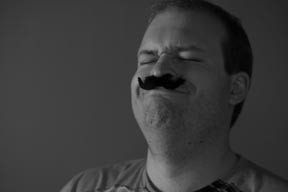
This image of the mechanical moustache was captured in a photograph which has since been donated by the Dutruv estate to the Art Institute of Portland. The subject, Dutruv's sometime laboratory assistant Tomasz Kolvski, described the sensation of the automated features as, "Initially foreboding, but afterwards, quite comfortable." The prototype was abandoned after Kolvski was injured by the cigarette-lighter feature, although unsubstantiated rumours persisted for some time that the Dutch military had purchased the rights to develop a weaponised version of the automated moustache from Dutruv.

©2010 James Mathurin

Thursday, 26 August 2010

The inventions of Dimitri Dutruv Pt. 3

Dimitri Dutruv developed the electric wig over the winter of 2003-4. In his design notes he said that the concept came to him while he was camping with his uncles in the Black Forest, 
"We found ourselves uncommonly annoyed by swarms of mites, midges and associated insects. I was reminded of the 'Insect-o-cutor' I had seen in a local butchers earlier that day. I was trying to imagine a suitable method of making such a device portable, when i could not help but to have my attention drawn to Uncle Berni's awful hairpiece. If a man was willing to wear such a thing for reasons of pure vanity, why not then one which could protect him from 6-legged annoyance?"
Dutruv developed an wig, filled with filaments of conductive wire, insulated against the scalp by a shower cap lining the interior, and a power source worn on a belt around a waist. The device could be activated by a switch on the belt buckle, which sent a charge through the wig, electrifying any insects which came into contact with it.

Dutruv's Uncle Yuri models the electric wig at his family home in 2004. There appears to have been a falling out between them after this photograph was taken, and it may have been caused by a house fire which was likely caused by the wig. Photograph provided by CarbonNYC.

©2010 James Mathurin