Etsy

Showing posts with label engineering. Show all posts

Sunday, 21 December 2014

Monday, 20 October 2014

Sunday, 31 March 2013

The world’s most excessive instruction manual


The world’s most excessive instruction manual is produced by Better Beverage Industries, of Houston, Texas. The manual accompanies their novelty Easter coffee mug, with scenes of the crucifixion around the outside, and the interior of the mug displaying a scene of Christ rising from his tomb, and has been packaged with the cup since 2006.

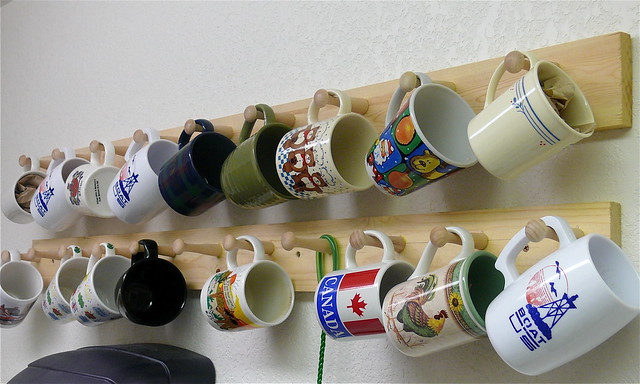
The manual runs for 95 pages, with detailed diagrams of the correct method of pouring in both hot and cold beverages (“It is not advisable to have a small child hold the cup above their heads while you pour boiling water into it.”), the correct way of holding the mug (“firmly, by the handle; do not raise arm higher than at a right angle to the body; do not consume while lying down; rest mug on a level surface, such as a table, when not in use.”), and the correct way of storing it (“If storing on a shelf, ensure the cup is fully on the shelf, and as little as possible is over the edge. If hanging from a hook, make sure that the hook is attached to something.”). 

The manual is multilingual, and has translations in French, German, Spanish, Italian, Klingon, Dutch, Portuguese, Afrikaans, Swedish, Zulu, Hieroglyphics, Norwegian, and (inspired by the Mel Gibson film, The Passion of the Christ) Ancient Latin.

An illustrative photograph from the manual, detailing on of 6 different examples of "cup racks, which may act as an alternative to shelves." The manual goes on to explain 7 differences between the methods of storage utilised with shelves and racks. Photograph by .Larry Page.

 ©2013 James Mathurin

Monday, 18 March 2013

The most over-priced computer repair


The most over-priced computer repair was carried out on the 11th November 2004, when Barry Quigley, a computer repairman from Wellington, New Zealand, charged $437.68 for removing a piece of Ham and Pineapple pizza from the CD-drive of Marty Halland’s PC.
“I feel sorry for him,” said Quigley at the time, ”but hopefully this will make him remember which appliance does what job. A month ago he asked me to defragment his dishwasher, and I had to charge him $25 for the call-out charge.”
Quigley took several photographs of the opened computer, explaining later that,
"I mean, come on! After pizza in the CD tray, I had no idea what else he had done to it, and I wasn't about to leave, I don't know, a goldfish on the motherboard, and have him say I put it there or something later.'"
Photograph by _rockinfree.

 ©2013 James Mathurin 

Monday, 25 February 2013

The lightest ever bulldozer


The lightest ever bulldozer was constructed by Hiromi “Shogun of Origami” Shumizuko of Tokyo, Japan. The working model, constructed almost entirely of construction paper, weighed in at 22 kilograms, and was used by Shumizuko to plough an acre of grassland in Shiretoko National Park, on the island of Hokkaido, Japan, in March 2002, until it collapsed in a light shower.


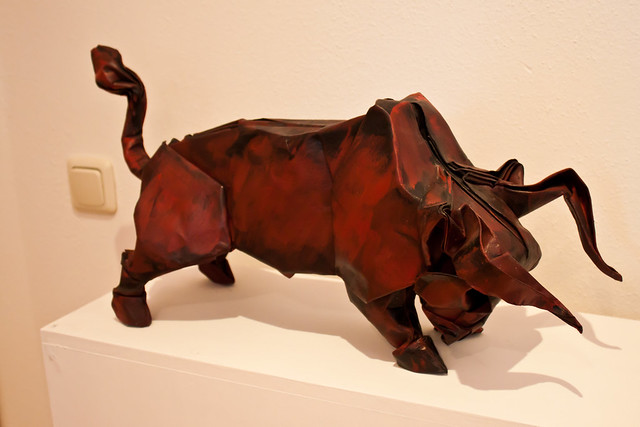
An origami bull which was also constructed by Shumizuko to accompany the origami bulldozer and a planned tractor in a field for an outdoors "Henry Moore-style" installation". When the bulldozer was ruined, Shumizuko abandoned the tractor project, and sold the bull to a private collector. Photograph by Scarygami.
 ©2013 James Mathurin 

Monday, 14 January 2013

The earliest public transport network


The earliest public transport network was a system of catapults unearthed in the ruins of the ancient Aztec city of Zingalamaduni, dated to around the 13th Century AD. With 17 temples and 3 palaces, it is believed that the catapults were devised to allow priests to perform several religious rites at different sites in quick succession, particularly at times of lunar or solar eclipse, when both sacrifices, marriages, baptisms and magistrates’ hearings would all be conducted within a very short time frame. It is believed that the system was abandoned after one disastrous eclipse, where a catapulting mix-up led to a groom being sacrificed, his bride-to-be being married to a new-born prince, a goat being baptised and the high priest being catapulted straight into the wall of a temple, killing him instantly.
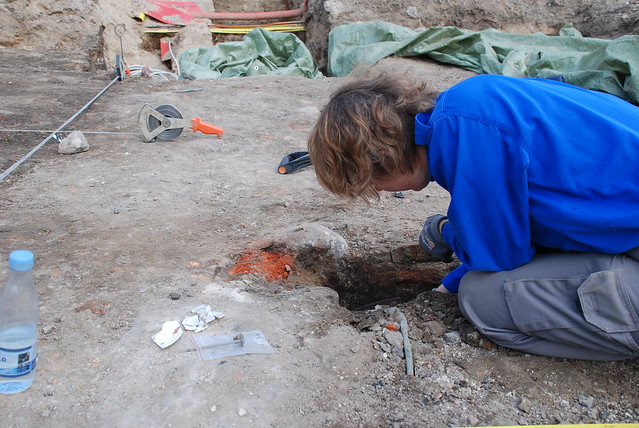
This photograph shows a team of archaeologists excavating the Zingalamaduni site in 2003. The site was hailed by the dig's leader, Professor Bryan Philpot, as a "truly exciting find, especially when I was accidentally thrown 20 metres by a remarkably well-preserved catapult!" Photograph by Odense Bys Museer.
©2013 James Mathurin

Monday, 19 November 2012

The most difficult musical instrument to play


The most difficult musical instrument to play is the Rimzeninger Organ, developed by renowned musicologist Otto Rimzeninger in 1897, it employs disused sewer tunnels or mineshafts to produce notes at volumes capable of knocking over a medium-sized cathedral, leading to it being recognised as a weapon rather than a musical instrument in Switzerland, Namibia and the American state of Indiana. It takes three people jumping in unison to sound one of the custom-built keys which are normally set up in a nearby field, or sports pitch, and the keys have to be at least 50 metres apart. At the last Rimzeninger concert, on 28th August 1924, it took 5 months to construct the organ, using a disused coal mine outside the City of Leeds in Britain; it took a further 3 weeks to tune the instrument, and the concert consisted of 4 movements over the course of fortnight, resulting in 9 deaths, 3 cave-ins, and £295, 876 worth of damage.

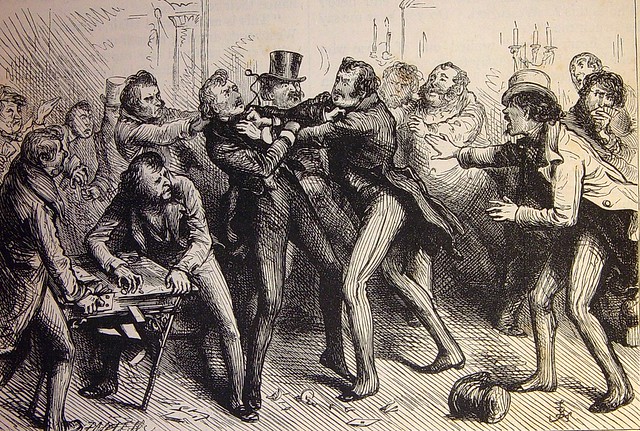
At a hearing to allocate compensation for the damage caused by the Rimzeninger Organ, Rimzeniger (pictured in the centre, wearing the top hat) arrived with a gang of "the Gentleman Brigands", a group of hard-drinking young aristocrats who were fans of his music and work. Rimzeninger then proceeded to direct them to attack anyone at the hearing who insulted his composition. Rimzeninger and the Gentleman Brigands were later given "stern rebukes" by the local police. Photograph by El Bibliomata.
 ©2012 James Mathurin