
Etsy

Showing posts with label history. Show all posts
Showing posts with label history. Show all posts
Sunday, 6 September 2015


Sunday, 21 June 2015

Sunday, 17 May 2015

Sunday, 8 February 2015
Quickest Holy Crusade Infographic
Frankly, crusades are never good news. If they had all been over as quickly as this one, it would have been for the best.

©2015 James Mathurin
Sunday, 7 December 2014
First Telephone Death Threat Infographic
Telephone harassment is a very serious problem, which has a longer history than many people are aware of.

©2014 James Mathurin
Monday, 15 September 2014
Citrus Cave Art: Infographic
The advent of agriculture and art were vitally important to human development. Here is a place where they crossed over.

©2014 James Mathurin
Sunday, 4 May 2014

Sunday, 9 March 2014

Sunday, 2 March 2014
The Sydney Nick-Name War Infographic
I was a London resident when I originally wrote this in 2010, but being a Sydney resident now, I suppose this is local history.

©2010 James Mathurin
Sunday, 9 February 2014
Tea in Orang-Utangerie Infographic
This is another entry which is not an update of a previous one, but is completely, totally, brand-new. Call it an early Valentine's day present.

©2014 James Mathurin
Sunday, 12 January 2014

Sunday, 3 November 2013
Oldest Public Transportation System infographic
An infographic of the archaeological dig that discovered the world's oldest public transportation system.
 ©2013 James Mathurin

Sunday, 29 September 2013

Sunday, 28 July 2013
The most argumentative person in the world
An infographic of Alexei Shamunshumovich, the most argumentative person in the world.

©2013 James Mathurin
Sunday, 21 July 2013

Monday, 25 March 2013
The most pointless speech
The most pointless
speech ever given was an address to the board of GlamSinClean inc. by one of
their Regional Directors, Gerald Hompknee, in 1991. In his presentation of annual
figures, he started reading from a piece of homework by his 6 year-old son
Jimmy, who had put it in his father’s briefcase for him to read. Mister
Hompknee later admitted, “When I started reading from Jimmy’s ‘Why I’m not scared to sit on the toilet any
more’ essay, I thought I was in real trouble at first, but I managed to
turn it into a metaphor for management strategies, and it was actually very
well received. In fact, I’ve had Jimmy and his little sister Elaine contribute
to every speech I’ve done since.”
©2013 James Mathurin
 |
| Hompknee, appearing at a University of Exeter conference on "Serendipity and Chaos Theory in Public Speaking" in 1999, . Photograph by University of Exeter. |
Monday, 4 February 2013
The world’s oldest chad
The world’s oldest chad is over 7, 000 years old. It was
found by archaeologist Shrivnee Bambaclart, on a dig near the site of the
Sphinx in Egypt in 2001. “I can categorically state that this is a chad, and not a
simple disc of paper,” said Bambaclart, announcing her discovery, “Electron
Microscope analysis of its edges reveals that it was punched and not cut from a
larger sheet of papyrus. What is truly fascinating, though, is that it predates
the use of papyrus in Egypt, and certainly predates the use of even the most
primitive of hole-punchers. I truly believe that this may represent a link to
the truth behind the legend of Atlantis.”
©2013 James Mathurin
 |
| The chad is analysed under electron microscopes at laboratories in Cyprus in 2002. Bambaclart's team, afte confirming the age of the chad, are planning to return to the dig site to confirm rumours of similarly-aged staples. Photograph by Robert Scoble. |
©2013 James Mathurin
Monday, 14 January 2013
The earliest public transport network
The earliest public
transport network was a system of catapults unearthed in the ruins of the
ancient Aztec city of Zingalamaduni, dated to around the 13th Century AD. With 17 temples and 3 palaces, it is
believed that the catapults were devised to allow priests to perform several
religious rites at different sites in quick succession, particularly at times
of lunar or solar eclipse, when both sacrifices, marriages, baptisms and
magistrates’ hearings would all be conducted within a very short time frame. It
is believed that the system was abandoned after one disastrous eclipse, where a
catapulting mix-up led to a groom being sacrificed, his bride-to-be being
married to a new-born prince, a goat being baptised and the high priest being
catapulted straight into the wall of a temple, killing him instantly.
©2013 James Mathurin
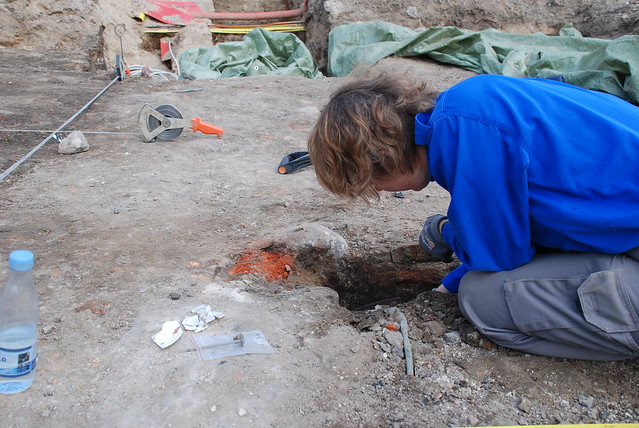 |
| This photograph shows a team of archaeologists excavating the Zingalamaduni site in 2003. The site was hailed by the dig's leader, Professor Bryan Philpot, as a "truly exciting find, especially when I was accidentally thrown 20 metres by a remarkably well-preserved catapult!" Photograph by Odense Bys Museer. |
Monday, 19 November 2012
The most difficult musical instrument to play
The most difficult
musical instrument to play is the Rimzeninger Organ, developed by renowned
musicologist Otto Rimzeninger in 1897, it employs disused sewer tunnels or
mineshafts to produce notes at volumes capable of knocking over a medium-sized
cathedral, leading to it being recognised as a weapon rather than a musical
instrument in Switzerland, Namibia and the American state of Indiana. It takes
three people jumping in unison to sound one of the custom-built keys which are
normally set up in a nearby field, or sports pitch, and the keys have to be at
least 50 metres apart. At the last Rimzeninger concert, on 28th
August 1924, it took 5 months to construct the organ, using a disused coal mine
outside the City of Leeds in Britain; it took a further 3 weeks to tune the
instrument, and the concert consisted of 4 movements over the course of
fortnight, resulting in 9 deaths, 3 cave-ins, and £295, 876 worth of damage.
©2012 James Mathurin
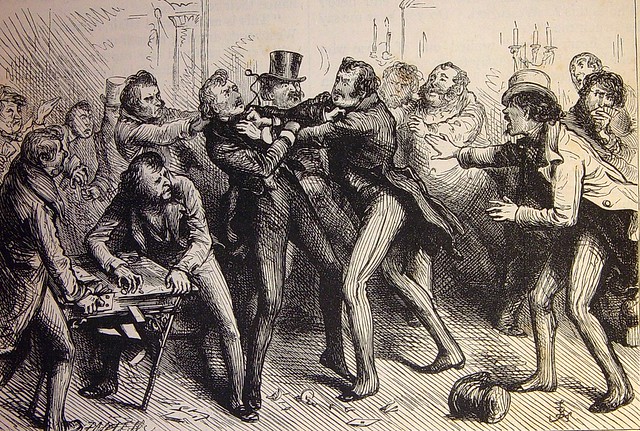 |
| At a hearing to allocate compensation for the damage caused by the Rimzeninger Organ, Rimzeniger (pictured in the centre, wearing the top hat) arrived with a gang of "the Gentleman Brigands", a group of hard-drinking young aristocrats who were fans of his music and work. Rimzeninger then proceeded to direct them to attack anyone at the hearing who insulted his composition. Rimzeninger and the Gentleman Brigands were later given "stern rebukes" by the local police. Photograph by El Bibliomata. |
Monday, 14 May 2012
The quickest ever Holy Crusade
The quickest ever Holy Crusade was over in 2 hours and 13
minutes on the 20th March 1853, when Edward Denison, the Bishop of
Salisbury, declared that a crusade would be organised to recover the Cap of
Alginon, a holy relic that was under his possession. He declared that the cap
had disappeared, and had been, “spirited away by agents of Beelzebub, probably
from Switzerland,” but after preparations had begun, it was discovered that one
of his maids had accidentally knocked the cap behind the Bishop’s drinks
cabinet.
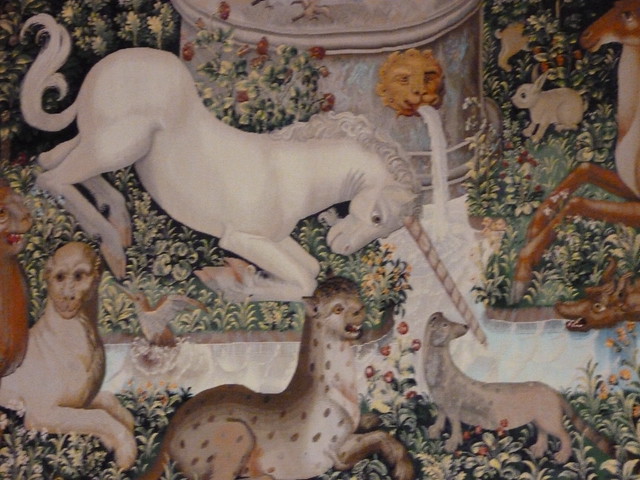 |
| This image of the parchment of Lower Divebeny, produced by a verger of Bishop Denison's parish to commemorate the "Crusade of the Cap", as it became known in satirical magazines of the time. The Unicorn is sad to represent the Bishop, the Dragon to represent a "Swiss Demon", and the unidentified creature (possibly a hyena), pictured at the bottom is said to represent an angel, leading the unicorn to the drinks cabinet and the hidden cap. Picture by grongar. |
©2012 James Mathurin
Subscribe to:
Posts (Atom)